What is precision-fermented protein? Has the UK approved it?
A UK protein bar developer who sources precision-fermented whey from a supplier already selling into the US might assume the ingredient itself is the hard part. It isn't. Perfect Day's precision-fermented beta-lactoglobulin cleared US self-affirmed GRAS status back in March 2020. Six years on, no UK or EU authority has approved a single precision-fermented animal protein for general food use, and that's true whether you check the UK's register or the EU's separately. The fermentation works. The approval doesn't exist yet, and not because anyone's application failed outright on safety grounds.
What precision fermentation actually is
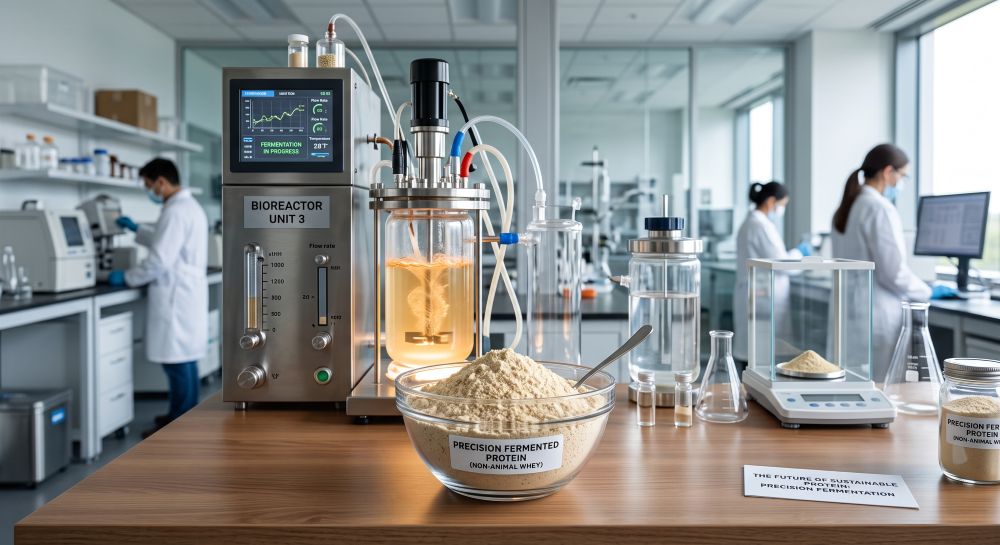
Precision fermentation is an old process aimed at a new target. Food-grade fermentation has used yeast and bacteria for centuries, in bread, beer, cheese and yoghurt. Precision fermentation takes a genetically modified microorganism, usually a yeast or fungus, and instructs it to produce one specific molecule instead of the usual fermentation by-products. As the FSA's own explainer puts it, it's "like brewing beer, but instead of alcohol, you're brewing the likes of milk proteins, collagen or even sweeteners."
The microorganism is grown in a fermentation tank and fed sugar. What comes out is the target protein itself, molecularly the same as the version made by an animal or plant, purified away from the microorganism that made it. No cow, no chicken, no soy plant is involved in the final ingredient. That's why Perfect Day can call its beta-lactoglobulin "animal-free" even though it's chemically identical to the protein in cow's milk. It's also why some precision-fermented ingredients, like certain omega-3 fats used in supplements, already have UK authorisation. The category isn't new. What's still missing is approval for an animal protein made this way.
Why this is worth knowing now
The FSA and Food Standards Scotland's thematic report on emerging food innovations, published 25 June 2026, ranks fermentation technology as the UK's largest area of food innovation activity by number of active companies: 34%, against 19% for cellular agriculture (cultivated meat). Both sit in the report's Tier 1, its "0 to 5 years" bracket for impact and feasibility, but the report itself describes fermentation as "well established and scalable" where cultivated meat still has "low market readiness."
That ranking sits oddly next to the approval picture. Three months earlier, on 12 March 2026, the FSA had already published dedicated guidance on how precision-fermented products actually reach market in Great Britain. It confirmed something UK food teams needed spelled out plainly: there's no shortcut. The production method doesn't create a new legal category. Whatever comes out of the fermenter still has to clear the same regime a conventional additive, novel food, or GM product would.
Two routes, and neither is a fast lane
Under the GB guidance, a precision-fermented ingredient lands in one of three regimes. Which one depends on what the final product actually is, not how it was made. Novel Food authorisation applies if it wasn't eaten in the EU before 15 May 1997. The Regulated Product route applies if it functions as an additive, enzyme, or flavouring. GM Food authorisation applies if the final product still contains recombinant DNA or viable microorganisms.
Food businesses have to register 28 days before starting operations and submit a full technical and safety dossier. They also have to work out whether their product counts as one "of animal origin," which changes which hygiene rules apply. The FSA recommends talking to them before you apply, not after.
Compare that with cultivated meat. The FSA built a dedicated Regulatory Sandbox for cell-cultivated products, launched in March 2025, with four applications currently under review and safety evaluations targeted for early 2027. That's a bespoke, faster-moving lane, built specifically because the standard novel food timeline was seen as too slow for this category. Precision fermentation, despite being the larger area of activity by the FSA's own count, got guidance rather than a sandbox. Same regulator, same year, two different sets of rules depending on which technology you're working with.
Why the US has seven approvals and the UK has none
The gap isn't really about the ingredients. It's about which legal mechanism a jurisdiction uses. In the US, a company can self-affirm that an ingredient is Generally Recognised As Safe (GRAS) using its own expert panel, without a mandatory pre-market government filing. That's a genuinely lighter-touch route: the company runs its own safety review and notifies the FDA, rather than waiting on a government dossier assessment.
That route has cleared at least seven precision-fermented proteins. Soy leghemoglobin from Impossible Foods (2018) is the protein that gives plant-based burgers their meat-like "bleed." Beta-lactoglobulin from Perfect Day (2020) and again from Remilk (2023) is a dairy whey protein used in ice cream, protein shakes and cheese analogues. Ovalbumin from The EVERY Company (2021) replaces egg white protein in baked goods and drinks. Brazzein from Oobli (2024) is an intensely sweet protein used as a sugar replacer. Casein from New Culture (self-affirmed, 2024) is the milk protein that gives cheese its stretch and melt. Collagen peptides from Geltor (2024) go into supplements and, increasingly, food and drink formulations.
The UK and EU each run their own mandatory pre-market dossier and scientific assessment, separately, since Brexit split the two processes. Neither has finished one yet for a precision-fermented protein.
On the EU side, Perfect Day's beta-lactoglobulin application was declared invalid in 2024. Remilk's application to the European Commission, for a beta-lactoglobulin made by fermenting a genetically modified strain of Komagataella phaffii, describes an ingredient that already has a positive FDA evaluation and approval in Singapore and Israel. The EU filing hasn't cleared.
The UK has its own live case. Perfect Day filed a separate application with the FSA's Advisory Committee on Novel Foods and Processes (ACNFP) in April 2022, for a beta-lactoglobulin made using a genetically modified strain of the fungus Trichoderma reesei. It's now been reviewed at three ACNFP meetings, most recently the 176th, in April 2026, where the committee was still working through data gaps on identity, production, composition, proposed uses, and allergenicity. The application is active, not stalled, but as of today it hasn't cleared either.
It's worth being precise here, because the EU's own novel food register can look like it contradicts this. Arla Foods Ingredients does hold a 2023 EU authorisation for something called bovine milk beta-lactoglobulin, and a French company, Armor Protéines, holds a UK authorisation for a bovine milk whey protein isolate dating back to 2018. Neither is precision-fermented. Both are isolated directly from real cow's milk through purification, which is a different, older kind of novel food story. The zero still holds for anything made by a microorganism in a tank rather than a cow.
The allergen problem waiting on the other side of approval
Even once a product clears authorisation, there's a labelling trap the FSA flagged directly in a June 2026 blog post. Precision-fermented dairy alternatives marketed as "animal-free" can still contain beta-lactoglobulin, a potent cow's milk allergen, because the protein itself is molecularly identical to the dairy version even though no animal was involved in making it.
"Animal-free" is a positioning claim. It isn't a food safety one, and the FSA was explicit that standard allergen labelling rules apply in full regardless of how the product is marketed. Businesses building for the UK market shouldn't assume a label built to satisfy another country's rules will satisfy this one, and allergen risk needs assessing at the start of development, not bolted onto the pack at the end.
What this means for a food team
Don't treat a supplier's US GRAS status, or a Singapore or Israel approval, as a signal you can use their ingredient here. Check first which of the three GB regimes your specific protein would actually fall into, because that decides your entire timeline and dossier requirement, not the marketing name on the ingredient spec sheet or how many other markets it's already cleared. If you're the one filing, budget years, not months, and go in knowing that as of today nobody in this category has finished the process in the UK or EU.
If a precision-fermented protein does reach your product, get the allergen assessment done at brief stage, not at pack design, because "animal-free" won't save you from a labelling failure on a genuine dairy allergen. And if a supplier tells you their ingredient is "already approved," ask exactly where, and check whether that approval covers the protein itself or just the production strain.
For teams evaluating whether to formulate around one of these ingredients at all, that's exactly the kind of decision worth modelling before committing R&D budget, since the regulatory clock on a genuinely novel protein can run longer than a product development cycle.
Frequently asked questions
Is precision-fermented dairy protein legal to sell in the UK right now?
Not yet, for general food use. No precision-fermented animal protein currently holds UK or EU market authorisation. Depending on the specific ingredient, a business would need to clear Novel Food, Regulated Product, or GM Food authorisation before it could go into a UK product.
Is any precision-fermented protein actually being assessed in the UK right now?
Yes. Perfect Day filed a UK application for a fermentation-produced beta-lactoglobulin in April 2022. As of the FSA's 176th ACNFP meeting in April 2026, it's still under review, with the committee working through data gaps on identity, production, composition, proposed uses, and allergenicity.
Why has the US approved more precision-fermented proteins than the UK or EU?
Because the US uses self-affirmed GRAS status, which lets a company determine safety through its own expert panel without a mandatory government pre-market filing. The UK and EU both require a mandatory dossier and scientific assessment before market access, a slower and more conservative route by design.
Does "animal-free" mean a product is allergen-free?
No. The FSA has stated directly that precision-fermented dairy alternatives marketed as animal-free can still contain proteins like beta-lactoglobulin, which triggers a genuine cow's milk allergy. Standard UK allergen labelling rules apply in full.
Is there a faster UK approval route for precision fermentation specifically?
No. Unlike cultivated meat, which has its own Regulatory Sandbox, precision-fermented products go through the same Novel Food, Regulated Product, or GM Food routes as any other ingredient, based on what the final product is rather than how it was produced.
If you want to track nutrition and compliance for your product, that's what we built Nibblr for. Try it here.